Private cloud adoption in capital markets isn’t new. We’ve seen firms steadily shifting away from one-size-fits-all infrastructure toward more purpose-built environments. But in 2026, the trend is accelerating. Not because of hype, but because of hard operational realities.
Firms are discovering the limits of generalist cloud strategies, especially when it comes to latency, cost and control which is leading to a more focused, performance-led approach to infrastructure.
Where hyperscale struggles to keep pace
Hyperscale cloud platforms offer broad flexibility and global reach, ideal for general-purpose workloads and rapid access to standardised services. But they weren’t built with capital markets in mind.
As trading workloads grow more complex and time-sensitive, firms are facing challenges in three key areas:
- Latency: Public cloud regions are rarely close enough to major liquidity venues to support low-latency trading
- Cost transparency: Egress fees and unpredictable billing models make cost management difficult at scale
- Customisation: Standardised environments can limit the ability to tailor infrastructure for specific regulatory, performance or integration requirements
These aren’t dealbreakers for every workload. But for latency-sensitive applications, trading platforms and infrastructure that underpins execution, they’re becoming difficult to ignore.
In a recent TradeNews article, Matt Barrett, CEO of Adaptive, summed it up clearly:
“The capital markets tech stack of the next decade is fundamentally different and deliberately engineered for continuous operations, fast recovery, and clean audit trails by design, not as afterthoughts…use cloud and tech accelerators to cut time-to-market while retaining control of the parts that truly differentiate them.”
A more strategic future-thinking approach
The shift isn’t necessarily back to legacy infrastructure, and nor should it. It’s toward a cloud designed for trading.
In 2026 firms need to prioritise platforms that offer:
- Private cloud environments built for capital markets
- Proximity to exchanges and data centres
- Flexible deployment and support models
- Predictable performance and cost structures
- Integration with existing risk, compliance and monitoring frameworks
We’re already seeing this play out in practice and having first-hand conversations with trading firms rethinking how and where they run core infrastructure. For some, that’s meant moving to dedicated cloud environments located near major venues, with control over latency and cost baked in from the start.
Strategy over standardisation
Cloud should no longer be treated as an off-the-shelf solution. It’s a strategic decision about where workloads run, how fast they respond, and how infrastructure can support both day-to-day trading and longer-term growth.
The future of cloud in capital markets looks more like a tailored platform than a universal utility. One that understands market structure, latency requirements, and regulatory complexity, and is built to meet them.
If you’re reviewing your infrastructure plans for the year ahead, join us for a focused webinar on how firms should be approaching the shift:
From Speed to Scale: Trading Infrastructure for Modern Markets
17th February 2026, 2–3pm GMT
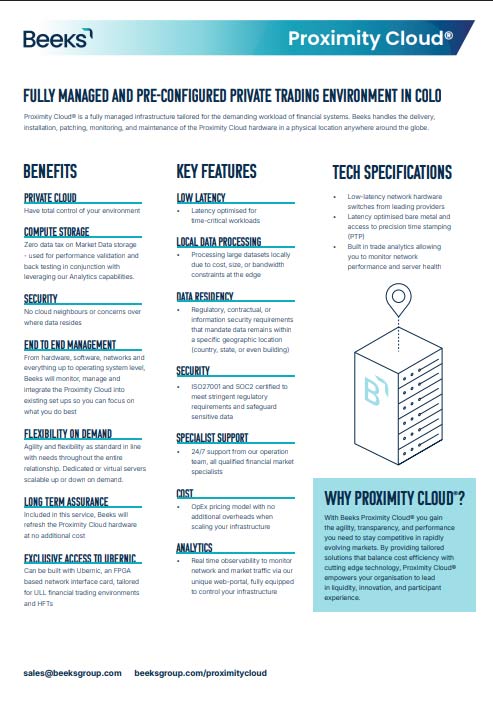
Or speak to our team about how Proximity Cloud® supports performance-led cloud strategy without compromise: