Major capital market infrastructure decisions have potentially been seen as trade offs:
- If you want maximum performance, you accept complexity.
- If you prioritise operational simplicity, you compromise on control.
- If you scale aggressively, you introduce fragility.
Hardware refresh cycles are typically manual and disruptive. Security controls layered on separately. Scaling often means redesigning environments from scratch. Performance tuning required specialist intervention. But are those choices still necessary?
During our recent webinar, the Beeks’ team explored how client expectations have shifted. Beeks Group CISO Oscar Neill’s perspective is that when firms are faced with infrastructure decision, they need to find the right balance between low latency, security and availability.
Richard McMahon added that:
“Another big factor driving the focus on maintaining consistent performance is resilience. Downtime now is a greater financial and reputational impact and resilience is expected by default… Market infrastructure must continuously evolve really to include redundancy, monitoring and failover, as well as automation built into the platforms”
When environments are pre-optimised, exchange-adjacent and architected as integrated platforms rather than assembled component by component, performance and predictability are no longer opposing forces. Embedded security frameworks remove the need for retrofitting controls. Elastic provisioning reduces the friction of scale. Automation reduces operational overhead.
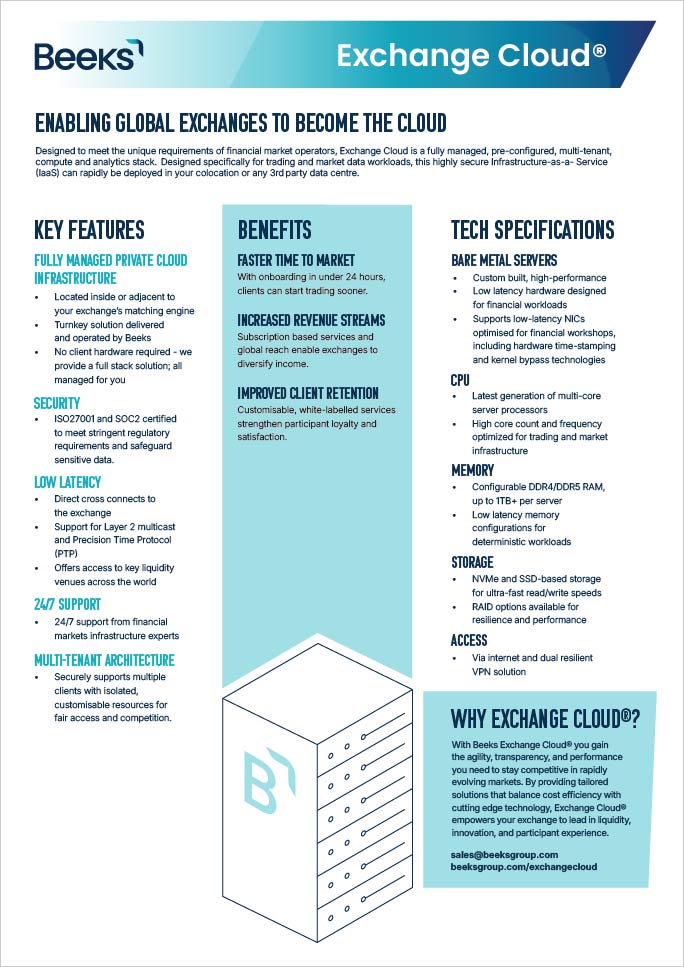
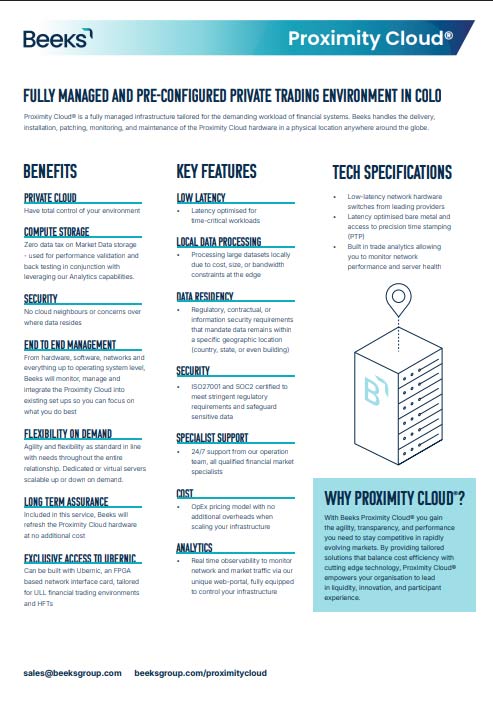
This is the model behind platforms such as Beeks Proximity Cloud® for trading participants and Exchange Cloud® for venues, infrastructure designed from the outset to balance performance, resilience and manageability. Instead of forcing firms to optimise one variable at the expense of another, the architecture is built to support them together.
In the webinar Q&A session, one attendee asked which change would deliver the biggest immediate impact: better automation, simpler operations, or more predictable performance. The honest answer? There is no easy choice, but the deeper insight was this: the tension between those priorities is beginning to fade. Modern infrastructure models reduce the structural reasons those trade-offs existed in the first place.
Fit-for-purpose infrastructure in 2026 should not force compromise. The emerging standard is performance, predictability and simplicity, delivered as a single operating model.
Contact us today to schedule a strategic conversation about your infrastructure for 2026 and beyond.