
Capital markets are changing. Global trading hours are expanding. New asset classes now operate without downtime. Client expectations are shifting fast, and much of the infrastructure in place today can’t support them.
As the industry edges closer to 24/7 operation, the infrastructure that underpins it is being tested, for uptime, flexibility, responsiveness and control. The question you should be asking isn’t whether your systems can stay on, it’s whether it’s built to keep up with the pressure that brings.
Continuous markets need continuous infrastructure
Most trading infrastructure was built around traditional market hours, daily cycles, downtime windows and fixed trading sessions. But as liquidity shifts and volumes spike beyond those boundaries, these systems are under strain.
Whether it’s supporting crypto, FX, or a growing appetite for extended hours in equities, firms are now asking:
- Can systems recover without manual failover?
- Is latency low and consistent across all hours and geographies?
- Can infrastructure scale with volatility, without disruption?
- Do support models reflect round-the-clock operation?
Different needs, same direction
The shift toward 24/7 affects everyone, but the operational demands vary.
- Exchanges and venues are expected to deliver continuous uptime, fast client onboarding, and full transparency across multi-tenant infrastructure. That includes reassessing how infrastructure is offered and where it runs.
- Trading firms; banks, brokers, hedge funds, and prop shops, need low-latency infrastructure with built-in resilience and global visibility, without managing every element themselves.
Regardless of where you sit in the market, infrastructure now plays a more active role in performance.
At Beeks, we work with both trading venues and participants as they adapt to this new infrastructure model.
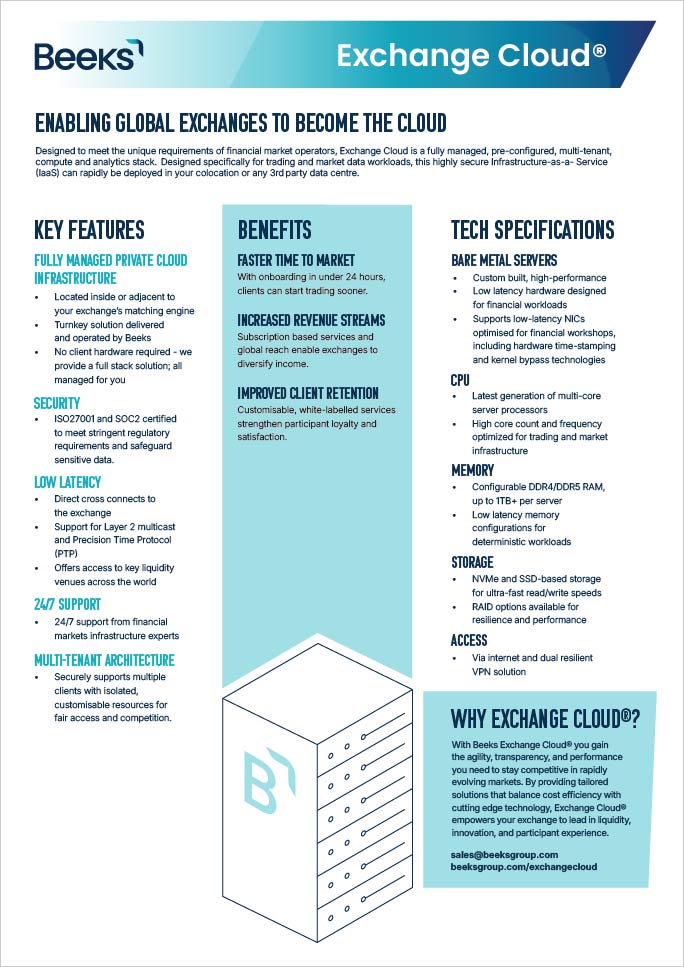
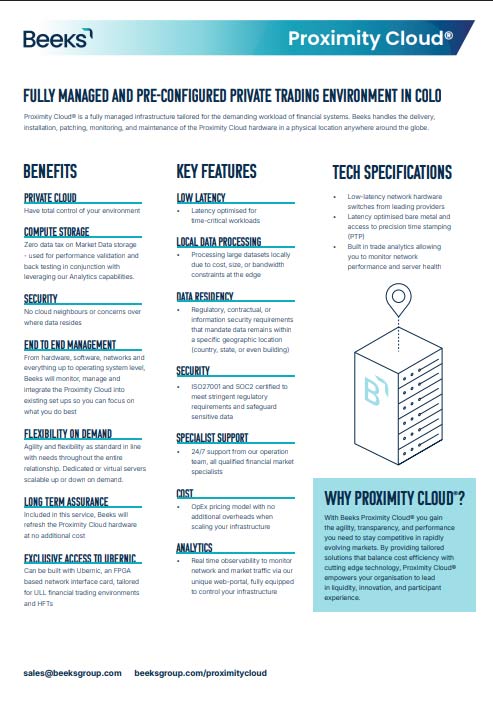
Proximity Cloud® and Exchange Cloud® are designed with that in mind. With secure, low-latency infrastructure deployed near key liquidity venues, full operational visibility, and flexible support models, they offer a scalable foundation that supports both current demands and future growth, including the path toward always-on trading.
If 24/7 trading is exposing gaps in how your infrastructure performs, you’re not alone. It’s one of many pressures shaping how capital markets firms think about speed, scale and control in 2026.
Join us for a focused discussion on how firms are reassessing infrastructure to meet today’s demands.
From Speed to Scale: Trading Infrastructure for Modern Markets
17th February 2026, 2–3pm GMT
Or get in touch to find out how Proximity Cloud® or Exchange Cloud® can support your next phase of growth: