
In 2025, we saw firsthand how firms are under pressure to reassess their infrastructure and understand if their technology stack truly supports trading operations, not just in terms of speed or availability, but across the full trade lifecycle.
Execution platforms remain essential. But as workflows become more interconnected, we’re seeing more focus placed on the broader infrastructure, systems supporting risk, compliance, data handling and post-trade. These are now playing a direct role in shaping decision-making and operational agility.
A shift in priorities
Firms are now operating in an environment where:
- Market activity is no longer confined to traditional hours
- Digital assets, new venues and regulatory pressures continue to expand
- The pace of change across client demands and technology is accelerating
In this context, mission critical now includes the infrastructure that ensures regulatory reporting is up to date, that data quality supports automated decision-making, and that control functions can respond without delay.
Even well-performing front-office systems can be held back by bottlenecks in adjacent processes or lack of visibility across platforms. These issues may not surface during normal trading activity, but during periods of volatility or scrutiny, the gaps appear quickly and can lead to delays, risk exposure and increased cost.
Building for performance
Legacy setups, layered solutions and disparate monitoring tools limit operational visibility. This slows response times and introduces operational risk, especially when under pressure.
Firms are beginning to feel the impact in three ways:
- Latency between systems: not just to market, but between internal workflows
- Gaps in observability: partial views that miss critical signals
- Rigid environments: deployments that can’t adjust quickly to change
The result is infrastructure that performs well in isolation, but lacks cohesion when it matters most.
This is leading to a more strategic approach to infrastructure. Common questions are moving from “is the system up and running?”, to:
- How quickly can we respond to unexpected market events?
- Can our post-trade infrastructure keep pace with front-office demands?
- Are we able to connect new risk or analytics platforms without disruption?
- What is the total operational cost of our current setup, in complexity, not just spend?
Asking these questions doesn’t mean starting from scratch. But it does mean evaluating what sits around your core systems, and whether it’s helping or hindering business operations.
Supporting connected infrastructure strategies
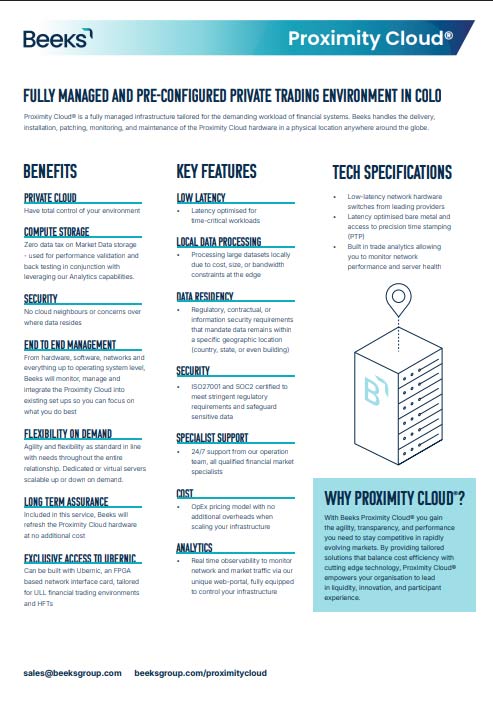
At Beeks, we’ve supported firms moving away from siloed deployments towards more integrated infrastructure models. Proximity Cloud®, for example, has helped firms deploy trading workloads closer to market, while retaining the flexibility to integrate with broader data, risk and compliance tools.
If you’re reviewing how your infrastructure supports not just trading, but the wider operational landscape, our recent webinar is a useful session to review:
From Speed to Scale: Trading Infrastructure for Modern Markets: Watch the recording.
Or download our Proximity Cloud® product sheet if you’re exploring how infrastructure can support connected workflows without adding operational complexity.