As infrastructure becomes more dynamic and distributed, security needs to evolve with it. But too often, firms still treat security as something to be added later, an overlay, or a hurdle that slows down progress.
That approach made sense when environments were relatively static. It doesn’t work in 2026.
Trading infrastructure now scales across regions, venues and asset classes. Capacity can be provisioned quickly. Strategies launch faster. Connectivity footprints expand. In that kind of environment, if security controls don’t scale automatically and consistently, gaps appear, not because firms are careless, but because architecture wasn’t designed for elasticity.
In our recent webinar alongside The Broker Club, Beeks’ CISO Oscar Neill made the case for a different approach:
“We’ve built our solutions to include security controls from the ground up, so from the network down to the compute itself… it scales with customer environments and it’s something that’s consistently monitored by our 24×7 Security Operations Centre (SOC) and also assured by third parties through ISO accreditations and SOC 2 report.”
Security controls that are embedded, not added-on, make it easier to maintain resilience as capacity scales, especially across multi-site or multi-venue deployments. For firms under pressure to launch new strategies quickly, or adapt infrastructure to support 24/7 trading, agility can’t come at the cost of security posture.
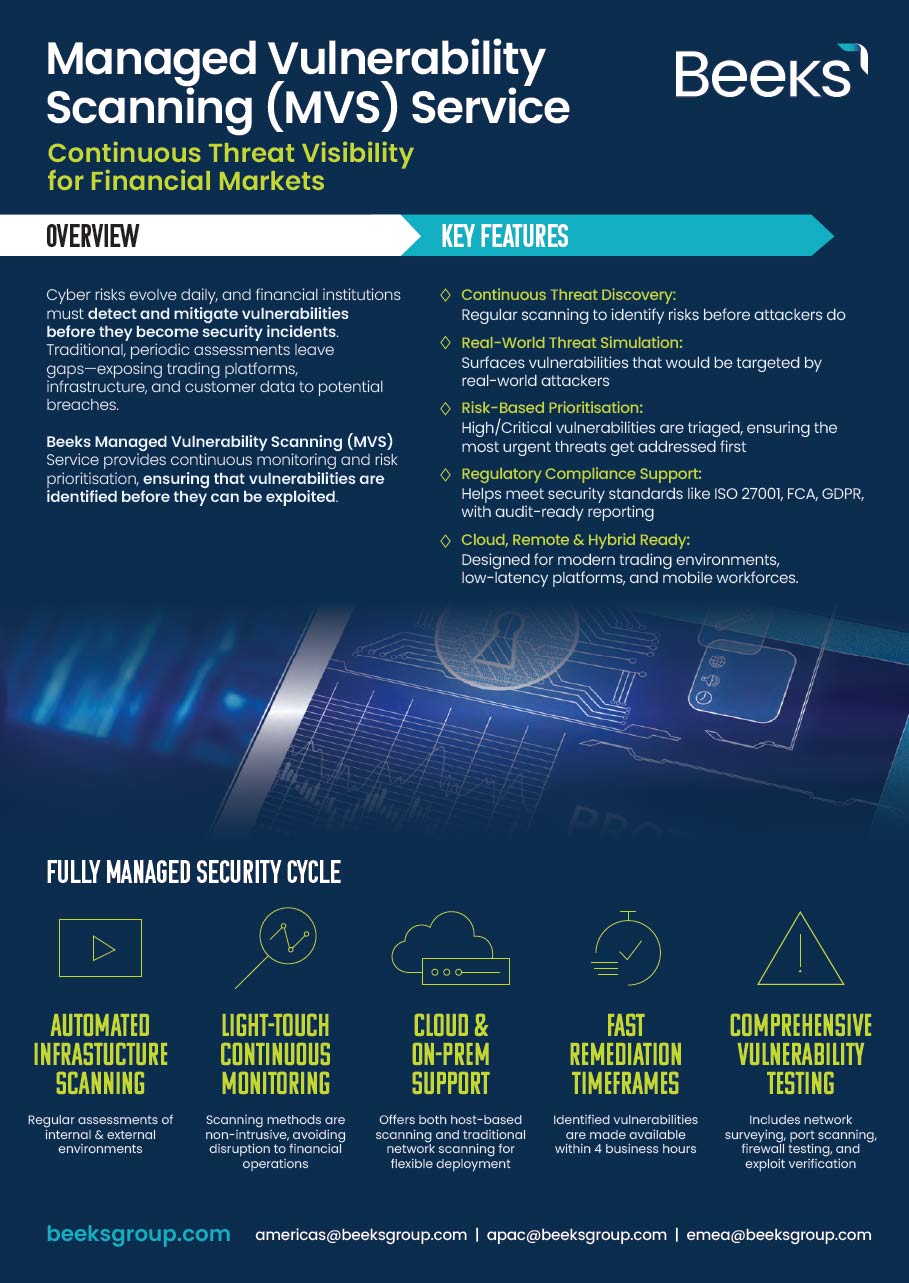
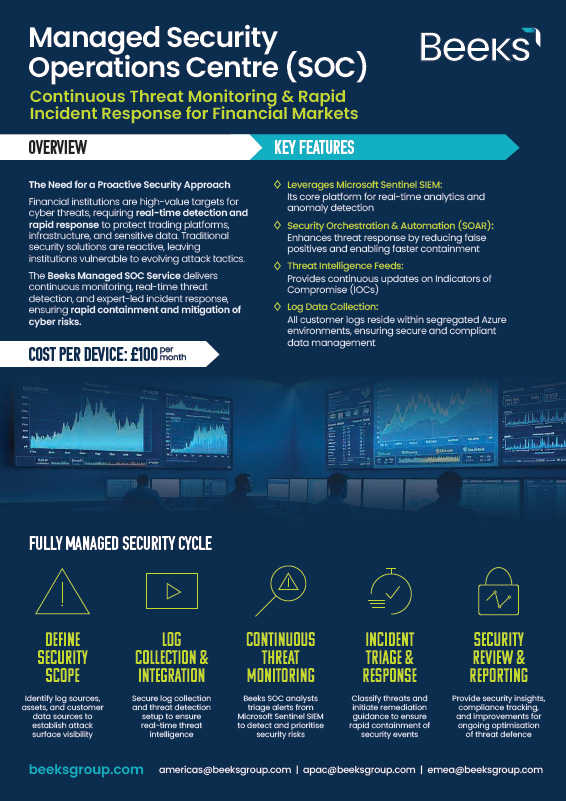
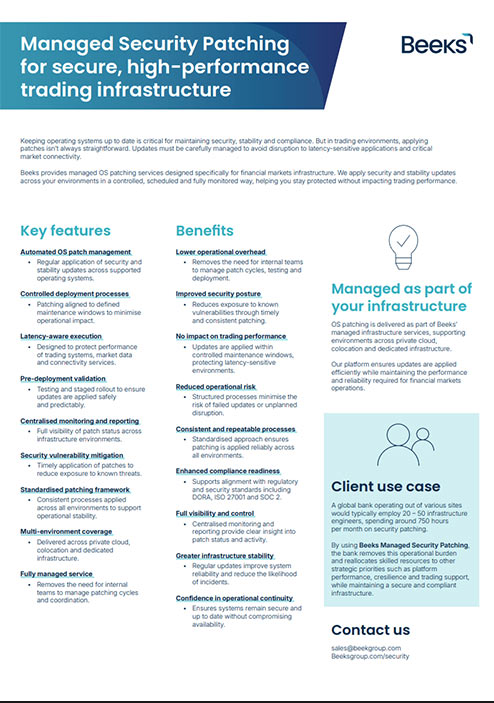
At Beeks, that posture is delivered through an integrated security and compliance framework embedded directly into our infrastructure platforms. From hardened operating system templates and strict network segmentation to role-based access controls, encryption, patch management, logging, monitoring and continuous vulnerability assessment, every environment is built with security as a foundational principle.
Importantly, this framework is not just technical; it is operational. Continuous monitoring, regular assurance testing, and alignment with recognised standards such as SOC 2 support firms facing growing regulatory scrutiny. As frameworks like DORA and NIS2 raise expectations around operational resilience, firms are increasingly required to demonstrate that controls are persistent, tested and scalable.
For organisations under pressure to launch new strategies quickly, expand into new markets, or support round-the-clock trading, agility cannot come at the cost of security posture. Embedded security reduces friction because it removes uncertainty. When controls are consistent and repeatable, infrastructure can scale with confidence.
Contact us to explore fit for purpose infrastructure that’s aligned with evolving regulatory frameworks and security scalability.