It goes without saying that low latency is still extremely critical for capital markets participants. But in 2026, it’s no longer the only priority or, in some cases, even the most important one.
As Martyna Stepien pointed out during our recent panel discussion:
“Speaking with my clients today, of course that latency aspect is still important… but I can definitely identify the shift towards maintaining consistent performance as volumes and strategies scale.”
That distinction matters.
A system that performs exceptionally well in steady-state conditions but degrades under burst traffic is not resilient. Nor is an environment that achieves impressive latency metrics in isolation but lacks transparency across the broader stack.
Performance without predictability is fragile. In modern trading environments, latency variance can originate from multiple layers; network congestion, compute saturation, storage bottlenecks, inefficient routing, or even operational processes. The complexity of today’s architecture means the root cause is rarely obvious. Without true end-to-end visibility, identifying the source becomes reactive and time-consuming.
Which is why observability is becoming central to infrastructure strategy.
Firms need real-time analytics that span the full environment enabling them to see not just what is happening, but where and why.
As firms push closer to liquidity venues to reduce execution time, the tolerance for inconsistency shrinks further. Proximity increases opportunity but it also increases sensitivity. The closer you are to the market, the less room there is for hidden bottlenecks or performance drift.
This is why modern trading infrastructure is required to combine proximity and embedded intelligence.
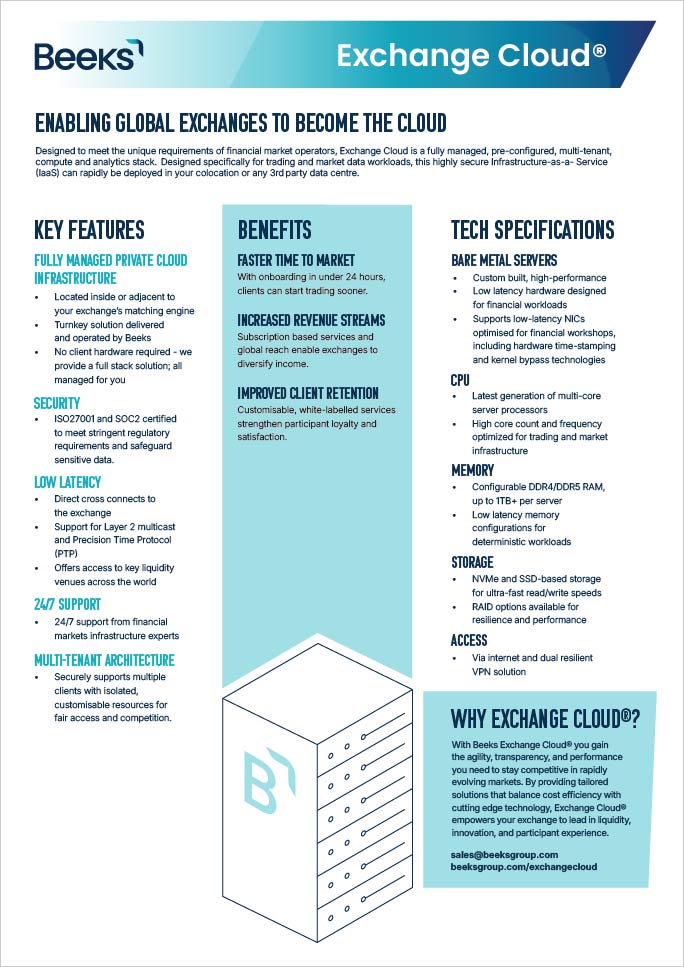
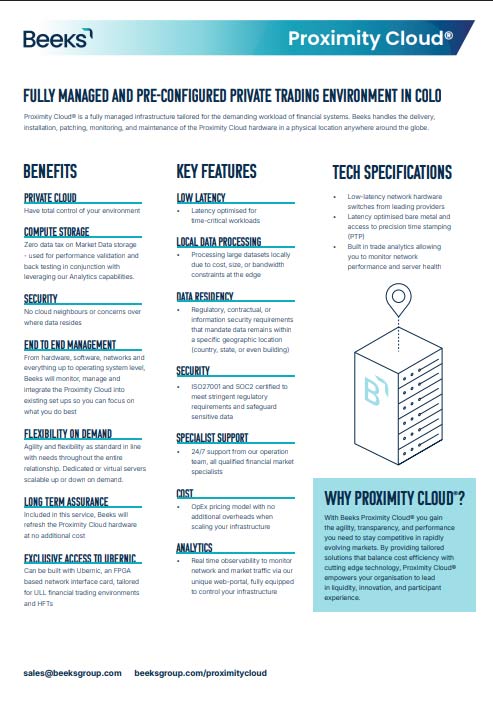
Rather than treating performance monitoring as an overlay, leading platforms are engineering analytics directly into the infrastructure layer. Within Beeks’ Proximity Cloud® and Exchange Cloud® environments, performance monitoring and network analytics can be integrated through Beeks Analytics, providing microsecond-level insight into traffic behaviour, congestion signals and performance consistency in real time.
This is complemented by capabilities such as Market Edge Intelligence®, which applies AI/ML at the infrastructure edge to identify patterns, detect anomalies early and provide predictive insight into potential performance issues.
Value is found in the confidence infrastructure brings to your business. When infrastructure can explain its own behaviour firms move from reacting to anomalies to anticipating them. They gain the clarity required to scale with assurance, validate consistency under pressure, and protect execution quality as volumes grow.
The conversation is shifting from “How fast are we?” to “How consistently do we perform under pressure?”. Fit-for-purpose infrastructure in 2026 must deliver both proximity and intelligence as part of the same foundation.
Curious to hear how this could fit into your business model? Chat to one of our experts and ensure your infrastructure brings value to your business.